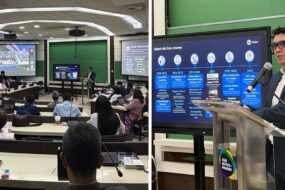


As the country grapples with the increasing frequency and intensity of natural disasters brought about by climate change, SM Prime Holdings is enhancing its efforts to create resilient and sustainable communities. The property giant remains committed to ensuring the integration of climate adaptation and sustainability into its projects.
SM Prime Holdings executive committee chairman Hans T. Sy believes the government and private sector must work together in finding solutions for greater resiliency so disaster risk reduction is one of its core business strategies.
“Resilience is not just a word, it is a way of life. It is a commitment to ensure that we act on our responsibility to care for others and that no one is left behind,” Sy said.
SM Prime Holdings recently marked its 30th year as a publicly listed company highlighted by its exemplary track record of sustainable development.
Sy said climate adaptation and resilience are keys to thriving despite damage and losses brought about by climate change, and SM has translated this to action with a significant portion of its capital expenditure allocated to incorporate resiliency and sustainability in its infrastructure designs
Sy, an engineer by profession, is passionate about constructing structures that are not only efficient but also strong and resilient. His commitment to disaster risk reduction is evident in his roles as a member of the Philippine board of ARISE Private Sector Alliance for Disaster Resilient Societies of the United Nations and co-chairman of the National Resilience Council.
SM Prime’s mall arm, SM Supermalls, has taken the lead in climate adaptation by implementing innovative solutions to mitigate flood risks.
One such example is the network of over 25 rainwater catchment basins strategically located across the country. These basins act as crucial buffers during heavy downpours, preventing flooding in surrounding communities.
“We’ve seen firsthand how our catchment basins have spared communities around our malls from severe flooding during typhoons like Carina. This validates our commitment to investing in sustainable and resilient infrastructure,” said Liza Silerio, SM Supermalls head for corporate compliance and sustainability.
She cited the SM Mall of Asia Complex, designed with a sturdy seawall to protect the surrounding communities from potential storm surges or rising sea levels. The property also uses specialized foundation systems to provide more robust protection against liquefaction and seismic events.

The first of catchment basins, built at SM City Masinag in 2011, has a capacity of 17,681 cubic meters – equivalent to over seven Olympic-sized swimming pools. Located underneath the premises of these catchment basin malls, the combined rainwater reservoirs have a total capacity of 85,272 cubic meters, collecting floodwaters and protecting nearby communities.
SM City Masinag’s rainwater catchment basin has lowered flood levels in villages along Marcos Highway.

Meanwhile, the United Nations Office for Disaster Risk Reduction (UNDRR) has recognized SM City Marikina for being a prepared facility during calamities. Its proximity to the Marikina River and the area’s flood history necessitated the mall’s elevation onto 246 concrete stilts, allowing flood water to enter and flow through the structure away from residential areas and avoid damage to the mall itself.
SM Supermalls, together with its holding company SM Prime, remain committed to its role as a catalyst for economic growth, delivering innovative and sustainable lifestyle cities, thereby enriching the quality of life of millions of people. SM Prime is pursuing the next horizon on integrated property development and onward to building sustainable cities of the future.