

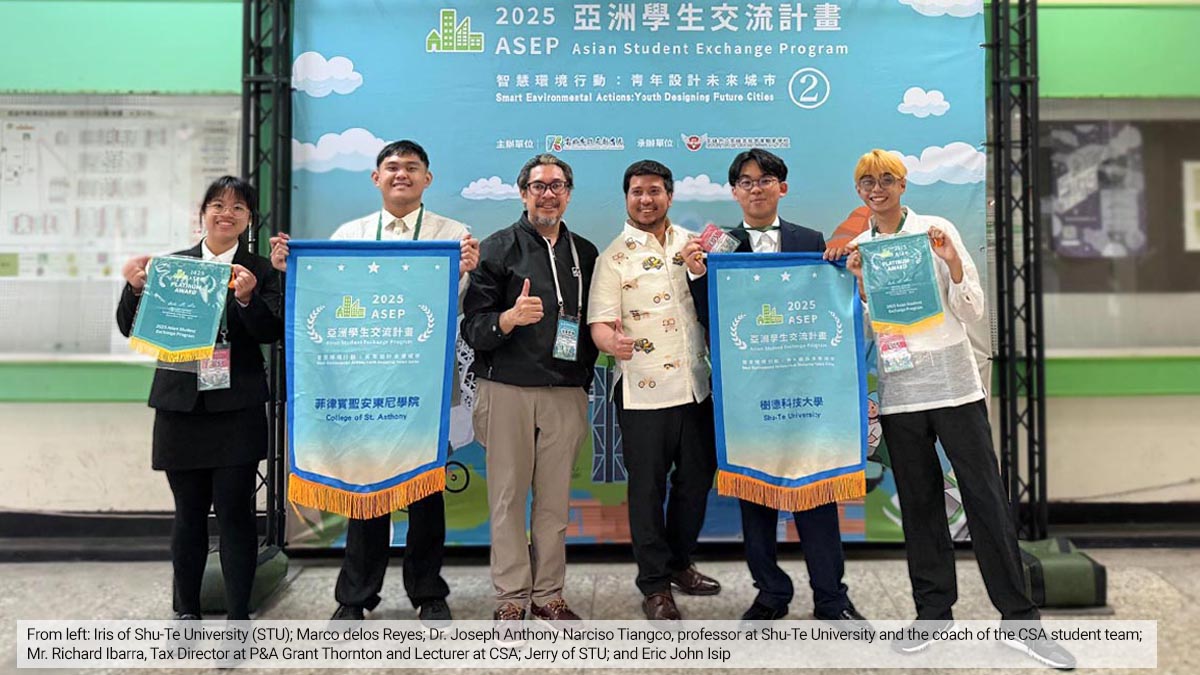
Students from the College of Saint Anthony – Higher Education Department (CSA-HED) once again proved their excellence on the international stage as Eric John Isip and Marco delos Reyes clinched the Platinum Award (1st Place) at the Asian Student Exchange Program (ASEP) 2025, held in December 2025 in Kaohsiung, Taiwan.
ASEP is an international program that brings together Asian students to collaborate and present innovative solutions to real-world challenges, fostering global citizenship and cross-cultural learning. This victory marks CSA’s second consecutive Platinum Award at ASEP, following its win in ASEP 2024.
Competing alongside students from different parts of Asia, Isip and delos Reyes, in partnership with students from Shu-Te University (STU), presented an innovative and culturally grounded proposal titled “Reimagined Urban Spaces with Community Bahay Kubo–Vertical Gardens.” Their sustainability-focused project impressed an international panel of judges for its creativity, social relevance, and meaningful cross-cultural collaboration.
Designing cities with compassion
The winning proposal aims to address two pressing issues: urban waste and homelessness. The team proposed transforming unused urban spaces into community vertical gardens by upcycling discarded wooden pallets and plastic bottles. Inspired by the traditional Filipino bahay kubo and the value of bayanihan, the project reimagines city spaces not only as environmentally sustainable but also as sources of food, dignity, and community care.

For delos Reyes, highlighting Filipino concepts on an international platform was a deliberate and meaningful choice. He emphasized that sustainability is not solely driven by technology but is deeply rooted in shared human values.
“Modern sustainability does not have to rely on technological advancements alone,” delos Reyes shared. “The bahay kubo concept reflects the cultural identity of bayanihan. [We believe this] transcends cultures and is not entirely new to countries like Taiwan. It was important for us to highlight this because this brings empowerment to a community in working together towards common goals.”
Isip echoed this vision, underscoring the role of youth in shaping more compassionate urban environments.
“Our project is about showing how youth can design smarter, more humane cities,” Isip explained. “The goal isn’t just sustainability or aesthetics, but creating urban solutions that actively care for vulnerable groups while engaging young people as co-designers of their cities.”
By integrating cultural heritage with practical urban planning, the project demonstrated how local traditions can be adapted to modern, global challenges.
“Modern sustainability does not have to rely on technological advancements alone. The bahay kubo concept reflects the cultural identity of bayanihan. [We believe this] transcends cultures and is not entirely new to countries like Taiwan. It was important for us to highlight this because this brings empowerment to a community in working together towards common goals.”
Jan Marco delos reyes
Cross-cultural collaboration in action
ASEP places strong emphasis on international teamwork, and the collaboration between CSA and Shu-Te University played a crucial role in refining the project. According to Isip, their Taiwanese partners, Iris and Jerry, provided essential insights into Kaohsiung’s urban landscape, helping ensure that the proposal was realistic and locally applicable.
“Filipino values like bayanihan shaped the community-driven spirit of the project, while Taiwanese perspectives grounded it in real urban systems and spaces,” he shared. “That balance made the solution both locally rooted and globally relevant.”
A memorable global stage
Presenting before an international audience proved both challenging and transformative. Language barriers and cultural differences added pressure, but the team turned these challenges into strengths through creativity and trust.
One of the presentation’s most memorable moments involved an interactive cultural performance: Isip and delos Reyes sang the Filipino folk song Bahay Kubo while their STU partners distributed fruits harvested from the conceptual vertical garden.
“We didn’t just talk about cultural exchange—we lived it on stage,” Isip said. “That made bayanihan tangible, not just theoretical.”
This powerful combination of performance, storytelling, and cultural authenticity resonated strongly with the judges and audience alike.
“Our project is about showing how youth can design smarter, more humane cities. The goal isn’t just sustainability or aesthetics, but creating urban solutions that actively care for vulnerable groups while engaging young people as co-designers of their cities.”
Eric John Isip
Lessons beyond the competition
While the award recognized their achievement, ASEP 2025 also offered enduring lessons for the students. Reflecting on the experience, delos Reyes highlighted the responsibility of youth in advancing global sustainability efforts.
“I’d like to continue doing my part as a student concerned for the environment through my actions, whether small or on a larger scale,” he said. “[ASEP] taught me that the youth have a significant role to play in society—and that we are capable of being real change agents.”

Isip similarly emphasized the importance of collaboration, communication, and creative engagement—skills he plans to carry into his future academic and professional endeavors.
“It taught me how crucial it is to truly connect with people from different cultures, especially when you combine teamwork with creativity and purposeful storytelling,” he said.
Strengthening global partnerships
CSA Assistant Director Dr. Tricia Montinola shared that the partnership between CSA and Shu-Te University began through academic ties, specifically through her college schoolmate Dr. Joseph Anthony Narciso Tiangco, a professor at Shu-Te University and the coach of the CSA student team. Dr. Tiangco initiated discussions about a possible collaboration between the two institutions, which later led to the formal signing of a Memorandum of Understanding (MOU)—laying the foundation for sustained academic cooperation and international student engagement.
With CSA now earning the Platinum Award at ASEP for two consecutive years, Dr. Montinola emphasized that recognition, while meaningful, is secondary to student growth.
“Our main goal is always for students to learn, grow, and develop strong values,” she said. “This achievement reflects the culture of excellence we aim to espouse at CSA—students who embrace challenges, collaborate effectively, and uphold strong values.”
Shaping globally minded leaders
Dr. Montinola also underscored the importance of programs like ASEP in shaping well-rounded, globally competent graduates. Through exposure to diverse cultures and real-world problem-solving, students gain essential soft skills such as adaptability, empathy, and communication.
“These experiences help our students grow beyond academics,” she said. “They become more confident, culturally aware, and ready to make meaningful contributions in an increasingly connected world.”